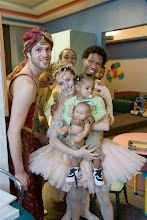
As Emily’s and Lasso’s work evolved, they reached out to the musical life in Memphis to listen carefully to what our community could bring to their search. The dancers are asked to give very internal, individual responses to the music and then take that feeling and widen it as they dance in groups. Lasso’s experience in Africa, Emily’s in the U.S., and the work built in Memphis are all steps in a process Emily and Lasso are producing at Yale University and in Burkina Faso. Now, they have added Ballet Memphis – and we are glad to support them. I would say that their deliberate, thoughtful process itself is a manifestation of work in community, among people reaching across barriers to go forward to create avenues of understanding.
Jane Comfort’s new premiere I Will Follow Him: A Brief History closes our program with a romp through the women’s story since 1950, and part of her preparation was Susan Douglas’ work Where the Girls Are and Gail Collins recent best-seller, When Everything Changed. For many of us, this will be a trip down memory lane, and a birthday celebration of sorts. But look carefully, and think carefully. How much more must be done? What do we expect of ourselves, of our daughters, our partners, our leaders? Who is listening? Who is seeing? What are we saying? How are we, in effect, continuing to present ourselves? According to us, according to others? Are we continuing to encourage both men and women, all children, all people, to support one another’s dreams and journeys?
If we believe our work as supporters of one another in different kinds of community is important, how do we help our nation look at community as something just as important as self? Are there glass ceilings because community still isn’t valued as much as the solo winner, pushing self forward above all else? Is there still too much “winner take all” mentality rather than “how can all become winners?”
I mentioned earlier “a place at the table.” The kind of table we set, and whom is seated there has mattered very much in our culture. We find women and men of all races now around our dinner tables, corporate conference tables, and operating tables. This is something all Americans can be proud of. We celebrate that progress together and still keep in mind that there are still many not at the feast. Let us keep creating, attending and supporting art that remembers this. Let’s support those journeys of new voices, new ideas, and expand the number of seats at our tables. Let’s make room for the voices which may be less powerful, and hear what they have to say. Let’s learn that those who are busy taking care of others are busy supporting us all.
Wednesday, February 9, 2011


Wednesday, February 2, 2011
Ask yourself this... part 1
Ballet Memphis has a core value of creating work that has meaning, and another core value that everyone in our society matters. Therefore, issues around who has a place at the table continue to be thread through the tapestry of performances we produce. This AbunDANCE: Where the Girls Are 2 is a part of an important national conversation, and naturally of great interest to me as I look back on the 24 years of our Ballet Memphis journey, plan for our future, and continue to make sure that what we do in our community has artistic, conceptual merit, and touches the deep concerns of the people with whom we live.
Today, more than half of the students in universities are women. In law school and medical school, the numbers are also reflecting this trend. Yet in ballet, there are only four women who direct fully developed, nationally respected ballet companies. How is this, when the great preponderance of young ballet students and their teachers are female? The voice of women in our field still needs nurturing, and serious questions need to be asked about patriarchal hierarchy and unconscious acceptance of old practices, attitudes and decisions.
In our performances in this two week run, you are seeing examples from some of the most thoughtful women in dance creation. Another work is a deeply personal creation by a former member of our company about the women who raised him in the Baltimore projects. There is also a fusion project between Emily Coates and Lacina Coulibaly of Burkina Faso which has in part evolved into a work that reflects women’s strength in supporting community.
Support is a rich word. It implies an ability to leave one’s self and assist another. In Kate Chopin's The Awakening, choreographed by our new Artistic Associate, Julia Adam, Edna cannot find a way to discover feelings and express her need to lead a life of her own; her conventional society exacerbates her yearning, her sense of living a caged life, and she tragically sees no way out of her sorrow. The palette of the work is pastel, yet that very softness points out how lost she is, how unclear her options seem.
Damien Patterson’s Four Women homage to the women who raised him points out a different time, a different place, built on the backdrop of the racial and gender struggle in America which he has known. These women supported one another, and it is this support from which they drew their strength.
Today, more than half of the students in universities are women. In law school and medical school, the numbers are also reflecting this trend. Yet in ballet, there are only four women who direct fully developed, nationally respected ballet companies. How is this, when the great preponderance of young ballet students and their teachers are female? The voice of women in our field still needs nurturing, and serious questions need to be asked about patriarchal hierarchy and unconscious acceptance of old practices, attitudes and decisions.
In our performances in this two week run, you are seeing examples from some of the most thoughtful women in dance creation. Another work is a deeply personal creation by a former member of our company about the women who raised him in the Baltimore projects. There is also a fusion project between Emily Coates and Lacina Coulibaly of Burkina Faso which has in part evolved into a work that reflects women’s strength in supporting community.
Support is a rich word. It implies an ability to leave one’s self and assist another. In Kate Chopin's The Awakening, choreographed by our new Artistic Associate, Julia Adam, Edna cannot find a way to discover feelings and express her need to lead a life of her own; her conventional society exacerbates her yearning, her sense of living a caged life, and she tragically sees no way out of her sorrow. The palette of the work is pastel, yet that very softness points out how lost she is, how unclear her options seem.
Damien Patterson’s Four Women homage to the women who raised him points out a different time, a different place, built on the backdrop of the racial and gender struggle in America which he has known. These women supported one another, and it is this support from which they drew their strength.
Thursday, December 2, 2010
What does Nutcracker really mean to society?
 A young girl named Clara believes that magic can happen, that she has the capacity to help turn the tide in a struggle for the better, and that she can help others experience beauty. Clara does what all of us can do in our own brief lives: She expands her experience of her first supportive and loving community—her family—to a larger gathering, and to a greater good, helping someone in need, and celebrating with people from around the world, each in their own cultural vocabulary.
For me, the Nutcracker invokes a deeper, more profound way of thinking. For example, I have long thought that the collective community of the Kingdom of Sweets is similar to the League of Nations, the forerunner to the United Nations. I also believe that the reason we, as humans, are distinguished from other living creatures is the capability to care about people we do not know. This Nutcracker ballet is an apt metaphor for what we believe in as people living in nations aspiring toward democratic principles in which people yearn for a better life and a kinder world.
I believe Nutcracker, with dancers deeply committed to their art form, its rigorous training and nearly impossible technical demands, speaks to a deep human longing for being better, to grow through struggle and hard work, to commit and give daily to others, not just in our families and workplaces, but in our communities and in our world.
It is the mysterious godfather Drosselmeier who arranges Clara's journey, an adult helping a child through the mysteries, struggles and accomplishments that will be hers. Drosselmeier is an adult who gives Clara something quite priceless, and as human beings and artists we are called to offer the priceless yet enriching mysteries as well.
Giving occurs throughout the Nutcracker story to lay the foundation for Clara’s transformative dream. A party with gifts is given; so is loving discipline when Fritz becomes greedy and jealous. A young teenage boy gives a shy girl a rose, a symbol of life and beauty. Good food and drink are generously distributed.
There is glorious pleasure for me as artistic director of Ballet Memphis as we produce and explore all season long the infinite possibilities of creating art through dance. On the stages where Ballet Memphis performs, we continue to quietly and profoundly express our belief that we can work together to be better and to share our gifts with you.
At our Ballet Memphis School, it is our honor to train children from all over the area in an atmosphere that nurtures trust, and provides the ability to quietly and sincerely begin listening to your body and soul. At our Pilates Centre, our licensed instructors help strengthen and heal bodies.
On this stage, and others across the nation, a desire to be captivated by beauty, dance and music as demonstrated by a nonspeaking art form takes place every December. It will forever be my hope that someday, this world on the stage will be the world we will walk in every day of our lives.
Monday, November 8, 2010
World Enough and Time part II
World Enough and Time....Why I don't believe ballet is over part II. (To read part I, click here)
As one of only 4 women leading ballet companies of a certain size and capability, I realized I had no desire to find "the next Balanchine", not because I didn't respect and admire his profound influence and gifts, but because I felt that looking for the next Balanchine was once again looking for an outside male savior, in many respects. It just doesn't seem like the right attitude. If women in the ballet world had been taught to find their own answers, I suspect there would be more of us making choreography and running ballet companies than there currently are. Furthermore, I was seeing a lot of lack-luster imitative choreography, coupled with a lot of steps that had no discernible meaning. It was time to help find ways to guide choreographers and dancers toward discovering meaning. If they understood and looked for meaning, perhaps they could pair their creations and their steps with renewed commitment to what lies at the base of our desire to be artists engaged in expressive dialogue.
As leaders in our field, artistic directors need to understand that the world around us, which we ask be reflected by our dancers and choreographers, is one full of possibilities. Take the stage as our setting, our metaphor. We can provide a place of almost limitless exploration because space is a gift we are honored to have time to fill while we walk, or dance, on this earth. Fill it how? With what theme? What questions? What sorrows and joys? What hopes? Isn't that how we want all human beings to move in the world? With questions, with delight, searching alone and together in community, in order to fill our world and time with value and meaning? If the flatness of the screen is affecting the thinking of people across our world, can we not call out to them and say "Look here! There is depth, intricacy, boldness! We illuminate space with our patterns and partnerships. There is room for so many. We work together, with dignity and respect for one another, and for the space in which we temporarily reside." Honestly, why don't we think of ourselves as ecologists of the human spirit?
There are other places in our country where people in our field are starting to address the need for change in the ballet world. It is very much still a patriarchal world, and the change is not really starting with the "big boys" in the big cities. This is understandable. The large cities of our nation have enough density and wealth to keep supporting, at least a while longer, what Ms. Homans sees and finds so discouraging. Those of us who live in closer proximity to the nation's "not so beautiful" know that these very people, these outliers, are often the ones whose voices, when heard, transform art. We need to closely read what is being written, hear what is being sung, experience what moves our population, and we can open a curtain behind which I believe we will find a vastness and potential we have long ignored. Furthermore, it is by seeing what we may not want to see, what we may not understand or be comfortable with, that we learn more about who we are as individuals and as people in relationship with others.
Ballet Memphis has re-enlivened story ballets and put dances in thematic context in our programming. We have investigated fused movement and local music and regional literature. We have done this without turning our backs on our training and our belief in what Ms Homans so eloquently calls our "inner truth and elevated state of being." I completely agree with her that there has been , in so many places, a forsaking of our sense of our capacity for transformation of the human spirit and our losing sight of what I believe is the enormous potential of human beings moving in the world together. However, I do not believe that this state has come about consciously. We reflect what we learn in our world. If it has become one of stricture, and of fear which blinds us, then our hope lies in our ability to reach a point where we can see what those blinders are and begin the challenging task of removing them.
We must become more conscious creators of dance. We must structure our companies and classrooms in ways that welcome "outsiders", in ways that guide and empower our young artists so that they do not feel they must conform to a structure run by a king, even if he is a benevolent despot. We must encourage curiosity and respect simultaneously, and model what is worthy of respect. We can encourage curiosity, thoughtfulness, tolerance, and give our emerging artists and audiences the understanding that they are not a part of an isolated fairy kingdom, but are a part of a world to which they can contribute hope, inspiration, and a meaningful context for exploration of ideas, experiences, and relationships. Ballet can awaken the sparkling spirit of a mysterious kingdom better than any art form I can think of, but this kingdom provides us a glimpse into attributes we share as humans that propel us forward together in a vast and ever-changing , often exciting, world. If we lose sight of why we dream about and create worlds of beauty, we stay lost in the mist.
I work in a ballet company that is truly alive. I think there are more of us out there. If we are singular, ( and I don't think we are,) we don't have to be. If the sparks are buried, I don't think they are yet suffocated. I have enormous hope. We need an awakened leadership that helps our artists, giving them the opportunity to see that "world enough and time" awaits their unselfish love , talent, and commitment to meaningful creation.
As one of only 4 women leading ballet companies of a certain size and capability, I realized I had no desire to find "the next Balanchine", not because I didn't respect and admire his profound influence and gifts, but because I felt that looking for the next Balanchine was once again looking for an outside male savior, in many respects. It just doesn't seem like the right attitude. If women in the ballet world had been taught to find their own answers, I suspect there would be more of us making choreography and running ballet companies than there currently are. Furthermore, I was seeing a lot of lack-luster imitative choreography, coupled with a lot of steps that had no discernible meaning. It was time to help find ways to guide choreographers and dancers toward discovering meaning. If they understood and looked for meaning, perhaps they could pair their creations and their steps with renewed commitment to what lies at the base of our desire to be artists engaged in expressive dialogue.
As leaders in our field, artistic directors need to understand that the world around us, which we ask be reflected by our dancers and choreographers, is one full of possibilities. Take the stage as our setting, our metaphor. We can provide a place of almost limitless exploration because space is a gift we are honored to have time to fill while we walk, or dance, on this earth. Fill it how? With what theme? What questions? What sorrows and joys? What hopes? Isn't that how we want all human beings to move in the world? With questions, with delight, searching alone and together in community, in order to fill our world and time with value and meaning? If the flatness of the screen is affecting the thinking of people across our world, can we not call out to them and say "Look here! There is depth, intricacy, boldness! We illuminate space with our patterns and partnerships. There is room for so many. We work together, with dignity and respect for one another, and for the space in which we temporarily reside." Honestly, why don't we think of ourselves as ecologists of the human spirit?
There are other places in our country where people in our field are starting to address the need for change in the ballet world. It is very much still a patriarchal world, and the change is not really starting with the "big boys" in the big cities. This is understandable. The large cities of our nation have enough density and wealth to keep supporting, at least a while longer, what Ms. Homans sees and finds so discouraging. Those of us who live in closer proximity to the nation's "not so beautiful" know that these very people, these outliers, are often the ones whose voices, when heard, transform art. We need to closely read what is being written, hear what is being sung, experience what moves our population, and we can open a curtain behind which I believe we will find a vastness and potential we have long ignored. Furthermore, it is by seeing what we may not want to see, what we may not understand or be comfortable with, that we learn more about who we are as individuals and as people in relationship with others.
Ballet Memphis has re-enlivened story ballets and put dances in thematic context in our programming. We have investigated fused movement and local music and regional literature. We have done this without turning our backs on our training and our belief in what Ms Homans so eloquently calls our "inner truth and elevated state of being." I completely agree with her that there has been , in so many places, a forsaking of our sense of our capacity for transformation of the human spirit and our losing sight of what I believe is the enormous potential of human beings moving in the world together. However, I do not believe that this state has come about consciously. We reflect what we learn in our world. If it has become one of stricture, and of fear which blinds us, then our hope lies in our ability to reach a point where we can see what those blinders are and begin the challenging task of removing them.
We must become more conscious creators of dance. We must structure our companies and classrooms in ways that welcome "outsiders", in ways that guide and empower our young artists so that they do not feel they must conform to a structure run by a king, even if he is a benevolent despot. We must encourage curiosity and respect simultaneously, and model what is worthy of respect. We can encourage curiosity, thoughtfulness, tolerance, and give our emerging artists and audiences the understanding that they are not a part of an isolated fairy kingdom, but are a part of a world to which they can contribute hope, inspiration, and a meaningful context for exploration of ideas, experiences, and relationships. Ballet can awaken the sparkling spirit of a mysterious kingdom better than any art form I can think of, but this kingdom provides us a glimpse into attributes we share as humans that propel us forward together in a vast and ever-changing , often exciting, world. If we lose sight of why we dream about and create worlds of beauty, we stay lost in the mist.
I work in a ballet company that is truly alive. I think there are more of us out there. If we are singular, ( and I don't think we are,) we don't have to be. If the sparks are buried, I don't think they are yet suffocated. I have enormous hope. We need an awakened leadership that helps our artists, giving them the opportunity to see that "world enough and time" awaits their unselfish love , talent, and commitment to meaningful creation.
Monday, November 1, 2010
World Enough and Time
World Enough and Time....Why I don't believe ballet is over
I have often felt a small tinge of alarm when I hear the word "like" which has crept into the vocabulary of our young, and into many older generations' speech as well. Jenifer Homans, in her article "Is Ballet Over?", speaks of today's ballet artists "not quite committing" as they dance. The word "like" is often inserted before a verb, as in "we were like hoping," " we were like thinking,", or "I was kinda like going this way..." If we accept the premise that there is probably a problem of commitment here, a fear of embracing action, and apply it toward the art of ballet, perhaps we can engage in a conversation about what we actually want to be committed to in the ballet world.
Some years ago, as a founding artistic director of a ballet company in a mid-sized city in the fly-over zone, I began asking questions about our purpose in the rapidly changing democracy in which we live and work and create art. What values do we hold that resonate in this world? How do we open our ballet world of idealistic hope and belief to others? How do we listen to what others say, and then nurture and create art and artists as members of a world, not a narrow kingdom? In ballet's history, artists who left the European capitals often returned with a greater understanding of what people bring to dance. I think particularly of the great Danish choreographer Auguste Bournonville (check spelling of both names please!) . By being attentive to other cultures and classes, he brought a recognizably human embrace to the ballet stage.
In a city like Memphis, with enormous social challenges and a culture so clearly enriched and influenced by black America, I have never felt that the white European aristocratic model was one in which we need to imprison ourselves. Neither did George Balanchine, as Ms. Homans points out so well. Exploring what others have to offer can broaden our language.
I have often felt a small tinge of alarm when I hear the word "like" which has crept into the vocabulary of our young, and into many older generations' speech as well. Jenifer Homans, in her article "Is Ballet Over?", speaks of today's ballet artists "not quite committing" as they dance. The word "like" is often inserted before a verb, as in "we were like hoping," " we were like thinking,", or "I was kinda like going this way..." If we accept the premise that there is probably a problem of commitment here, a fear of embracing action, and apply it toward the art of ballet, perhaps we can engage in a conversation about what we actually want to be committed to in the ballet world.
Some years ago, as a founding artistic director of a ballet company in a mid-sized city in the fly-over zone, I began asking questions about our purpose in the rapidly changing democracy in which we live and work and create art. What values do we hold that resonate in this world? How do we open our ballet world of idealistic hope and belief to others? How do we listen to what others say, and then nurture and create art and artists as members of a world, not a narrow kingdom? In ballet's history, artists who left the European capitals often returned with a greater understanding of what people bring to dance. I think particularly of the great Danish choreographer Auguste Bournonville (check spelling of both names please!) . By being attentive to other cultures and classes, he brought a recognizably human embrace to the ballet stage.
In a city like Memphis, with enormous social challenges and a culture so clearly enriched and influenced by black America, I have never felt that the white European aristocratic model was one in which we need to imprison ourselves. Neither did George Balanchine, as Ms. Homans points out so well. Exploring what others have to offer can broaden our language.
Sunday, October 10, 2010
 For this, our 24th season, we have chosen the theme “Telling Our Stories,” because our world narrative, in which we are all contributors—willingly or otherwise—is so full of important stories. We hold the great gift at Ballet Memphis to be able to tell these stories through our dance. Truly, they are unique and worthy perspectives that deserve to be heard, seen, felt and appreciated. In every work we perform, whether classical, reimagined or completely new, our dancers will seek to create meaningful connections. That may be in a more intimate space, between two people onstage, or in a larger setting, with audience members and dancers moving physically and emotionally through the same range of thoughts and emotions.
 It’s an awesome task that we at Ballet Memphis assume in a heartfelt and significant way. And how fortunate we are to be living here in the soul of this country, with so much great history and music from which to draw. Some of the best writers, certainly the best musicians, and artists of all kinds have been born, raised and sent from this rich Southern region. So many women, in particular, came from this place and have helped shape me, and I hope they will continue to
mold the next female generations. That is why we carry the mantle of their work, to explain and interpret these people who paved the way for us and who have made our lives more fulfilling in the process. Their work—their stories—have to continue on to keep our world moving into an even better place.
Please keep telling your own important stories, and never underestimate their influence on family, friends and those who may fleetingly pass through your life.
Saturday, May 8, 2010
We’re Telling Our Stories for Our 24th Season!

For our 24th season, we’re telling our stories in a whole new light. From setting a new stage with area artists of all kinds with FUSE, to a foodie’s dream event where top local chefs are challenged to create a new chapter with homegrown ingredients. Plus, three famous stories choreographed just for Ballet Memphis, including the premiere of an all-new Romeo & Juliet. Our AbunDANCE series adds a new chapter with renowned female choreographers and musicians presenting four new short works right here on this stage. And setting the stage for our 25th anniversary season, we’re taking it outdoors to the Memphis Zoo for a season wrap under the stars.
FUSE Sept 18
Connections: Food Oct 9
A Midsummer Night’s Dream Oct 30–Nov 7
Nutcracker Dec 10–12
AbunDANCE: Where the Girls Are Feb 19–27
Romeo & Juliet Apr 9–17
Connections: Outdoors May 14
Subscribe to:
Posts (Atom)