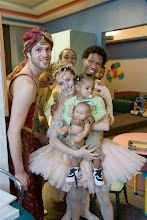
For some, an anniversary is a time of reflection. Although it is for us as we celebrate 25 years, we also see it as a chance to lift Memphis higher, and reach even further into our community. During this special season we are embarking on an unprecedented nine tours from Florida to California; beginning a new Connections: Kids series to help battle childhood obesity; taking our FUSE program into STAX Music Academy; and even starting a new Pas de Brew free studio event for our patrons. But not unlike our other seasons we're also presenting six new works, including ones from Julia Adam, Matthew Neenan, Steven McMahon, Travis Bradley, Julie Niekrasz and Kendall Britt. Take a look at our 25th season, and let us know your thoughts, buy a season ticket, attend a performance or an outreach, even volunteer. We know we wouldn't be where we are today without all of the patrons, donors, students, corporations, dancers, staff, choreographers and more; but we also know that when we work together, we reach further.
Tuesday, August 2, 2011
Reaching Further
For some, an anniversary is a time of reflection. Although it is for us as we celebrate 25 years, we also see it as a chance to lift Memphis higher, and reach even further into our community. During this special season we are embarking on an unprecedented nine tours from Florida to California; beginning a new Connections: Kids series to help battle childhood obesity; taking our FUSE program into STAX Music Academy; and even starting a new Pas de Brew free studio event for our patrons. But not unlike our other seasons we're also presenting six new works, including ones from Julia Adam, Matthew Neenan, Steven McMahon, Travis Bradley, Julie Niekrasz and Kendall Britt. Take a look at our 25th season, and let us know your thoughts, buy a season ticket, attend a performance or an outreach, even volunteer. We know we wouldn't be where we are today without all of the patrons, donors, students, corporations, dancers, staff, choreographers and more; but we also know that when we work together, we reach further.


Wednesday, May 11, 2011
Earth and Sky
As we bring our glorious professional company and creativity to, yet again, a new venue—the grove at Memphis Zoo’s Teton Trek—what better way to celebrate than to connect our thoughts and minds to the natural world around us. Stopping to think about how distinctly valuable and vital the earth is to who we are, how we have been formed and what future we leave to our descendants is imperative, and can help us stop and be grateful for our bountiful surroundings.
With the three choreographers whom I engaged in making these new works based on water, earth and sky, I was most specific with Mikelle Bruzina. Last June, when Ballet Memphis performed at the John F. Kennedy Center for the Performing Arts in Washington, D.C., I happened to take in a startlingly beautiful exhibit at the Renwick Gallery, part of the Smithsonian Museums. The exhibit was called The Art of Gaman and was based on the amazing art that Japanese American citizens made while interred in camps during WWII, two of which were just across the river in Arkansas. While that chapter in our history is a shameful one, what I saw was the indomitable spirit of survival and perhaps even gratitude for the earth around them.
These citizens created impressive work from stones, seeds, pipes, sticks and nearby materials on the ground. It was breathtaking yet poignantly sad and wonderful. The will to survive, to stay grounded and sane, was seen in their engagement in creating beautiful objects from their surroundings. Mikelle’s mother and grandparents were in one of these camps, so her sensitivity and
history were perfect for this project. So, as you see our Hideko born aloft like a bird, think about this: the earth is what grounds us, even as we reach upward in flight for hope, release, light and freedom.
Petr Zahradníček has actually studied meteorology, so the fact that he chose clouds to think about was no surprise. He uses their formation, change and dispersal to express his fear that human beings might realize too late that we must cherish and take care of our earth and its atmosphere. The very breath that gives us life is gently at the base of this abstract and tender work.
Julia Adam looks at water in her own inimitable and interesting way. As water touches us so often, you will see divining, sailing, swimming—and be reminded about how taking a plunge might mean a myriad of different possibilities, both real and metaphorical. As water lays in various pools around us, or flows through our earth, how can we not think of the timeliness of this new work?
Across the Pacific Ocean, the Japanese people are trying to deal with an environmental disaster of huge proportions. The river we live beside has crested to new flood levels, and the sky has been gray and twisted into tornadoes that have damaged huge swaths of land, buildings and lives all around us. Yet we gather together with family and friends to think carefully and enjoy fully the better side of who we can be, dancing again to tell our stories and explore our connections to each other and to our world.

With the three choreographers whom I engaged in making these new works based on water, earth and sky, I was most specific with Mikelle Bruzina. Last June, when Ballet Memphis performed at the John F. Kennedy Center for the Performing Arts in Washington, D.C., I happened to take in a startlingly beautiful exhibit at the Renwick Gallery, part of the Smithsonian Museums. The exhibit was called The Art of Gaman and was based on the amazing art that Japanese American citizens made while interred in camps during WWII, two of which were just across the river in Arkansas. While that chapter in our history is a shameful one, what I saw was the indomitable spirit of survival and perhaps even gratitude for the earth around them.
These citizens created impressive work from stones, seeds, pipes, sticks and nearby materials on the ground. It was breathtaking yet poignantly sad and wonderful. The will to survive, to stay grounded and sane, was seen in their engagement in creating beautiful objects from their surroundings. Mikelle’s mother and grandparents were in one of these camps, so her sensitivity and
history were perfect for this project. So, as you see our Hideko born aloft like a bird, think about this: the earth is what grounds us, even as we reach upward in flight for hope, release, light and freedom.
Petr Zahradníček has actually studied meteorology, so the fact that he chose clouds to think about was no surprise. He uses their formation, change and dispersal to express his fear that human beings might realize too late that we must cherish and take care of our earth and its atmosphere. The very breath that gives us life is gently at the base of this abstract and tender work.
Julia Adam looks at water in her own inimitable and interesting way. As water touches us so often, you will see divining, sailing, swimming—and be reminded about how taking a plunge might mean a myriad of different possibilities, both real and metaphorical. As water lays in various pools around us, or flows through our earth, how can we not think of the timeliness of this new work?
Across the Pacific Ocean, the Japanese people are trying to deal with an environmental disaster of huge proportions. The river we live beside has crested to new flood levels, and the sky has been gray and twisted into tornadoes that have damaged huge swaths of land, buildings and lives all around us. Yet we gather together with family and friends to think carefully and enjoy fully the better side of who we can be, dancing again to tell our stories and explore our connections to each other and to our world.
Saturday, April 9, 2011
Staying Power Part 2
He has told the story of Romeo and Juliet’s passionate and youthful love for one another, one that eliminates the separate self and expands into a new entity, an exaltation of existence beyond and bigger than who they are separately. This is, in my mind, one of the most important stories we share in our human life. We repeatedly search for something that is bigger than we are, call it God, the divine, the greater consciousness, infinite belonging, whatever you choose. When we have lost touch with it, as we inevitably do in our human fallibility and frailty, some form of deep sadness, and far too often tragedy and suffering, befall us and those around us. In the brief space of this story this is the journey we take together.
Ballet can be so beautiful. Its idealistic form and vocabulary is in almost continual consummation. Dancers and audience become one in our Romeo & Juliet, vividly present in the moment of life and death, reaching deep within to go beyond limitations. Indeed, the journey is exhilarating and often exhausting. It is not a place in time or space for people who do not want to feel the bare, the acute that puts us starkly in touch with life and death, just as this story of Romeo and Juliet does.
In this, our ballet, human mutability, utter ecstasy and destructive tragedy confront us, leaving us what? I hope with the belief that we must identify our worst in order to support our best. I hope with an understanding that we must continually try harder to forgive. I hope with the reminder that we must build a world where our young are given love’s expansiveness, not the constrictive fear of those who are different or those with whom we disagree.
Enter if you dare—to be delighted or to be profoundly shaken. But if we do not enter its world, we cut ourselves off from our self, from one another and from the promise we could each fulfill before our own story ends.
Ballet can be so beautiful. Its idealistic form and vocabulary is in almost continual consummation. Dancers and audience become one in our Romeo & Juliet, vividly present in the moment of life and death, reaching deep within to go beyond limitations. Indeed, the journey is exhilarating and often exhausting. It is not a place in time or space for people who do not want to feel the bare, the acute that puts us starkly in touch with life and death, just as this story of Romeo and Juliet does.
In this, our ballet, human mutability, utter ecstasy and destructive tragedy confront us, leaving us what? I hope with the belief that we must identify our worst in order to support our best. I hope with an understanding that we must continually try harder to forgive. I hope with the reminder that we must build a world where our young are given love’s expansiveness, not the constrictive fear of those who are different or those with whom we disagree.
Enter if you dare—to be delighted or to be profoundly shaken. But if we do not enter its world, we cut ourselves off from our self, from one another and from the promise we could each fulfill before our own story ends.
Saturday, April 2, 2011
Staying Power
The staying power of certain age-old stories continues to strike me with awe and appreciation. When those stories are retold in various forms of artistic communication, we see our continued need to be in touch with our deep urges and desires, and to relearn (hopefully with a more resonant understanding), where those urges may lead us, good and bad.
Enter if you dare into this heart-wrenching narrative of first love, its capacity for self-annihilation, where two become one—only to be destroyed by the petty hatreds and jealousies of those in power. (Here it is the parents.) Youthful bliss, hopes and dreams come crashing down, crushed by the burdens and missteps of age-old prejudices, happenstance and uncontrolled tempers. When all is said and done, when the beautiful Prokofiev score ends, let us hope we have within ourselves to own our capacities and actions not only for bliss, but for wickedness and pain, for destruction of innocence, and for the lifelong process of forgiveness.
While watching this work’s creation by our astute, sensitive choreographic associate Steven McMahon, I have witnessed a significant step forward in his understanding of human nature and ballet’s ability to express that nature. This has been apparent to our dance artists also, and their responses show their growth as they reach deeply into a wellspring of discovery. This choreographer is not one who glosses over the weight of the story he is asked to illuminate. He is a young person with an old soul.
Enter if you dare into this heart-wrenching narrative of first love, its capacity for self-annihilation, where two become one—only to be destroyed by the petty hatreds and jealousies of those in power. (Here it is the parents.) Youthful bliss, hopes and dreams come crashing down, crushed by the burdens and missteps of age-old prejudices, happenstance and uncontrolled tempers. When all is said and done, when the beautiful Prokofiev score ends, let us hope we have within ourselves to own our capacities and actions not only for bliss, but for wickedness and pain, for destruction of innocence, and for the lifelong process of forgiveness.
While watching this work’s creation by our astute, sensitive choreographic associate Steven McMahon, I have witnessed a significant step forward in his understanding of human nature and ballet’s ability to express that nature. This has been apparent to our dance artists also, and their responses show their growth as they reach deeply into a wellspring of discovery. This choreographer is not one who glosses over the weight of the story he is asked to illuminate. He is a young person with an old soul.
Monday, March 7, 2011
We Tell Memphis' Story
I was recently asked to answer the question of why I, along with the rest of the Ballet Memphis family, do "Memphis Project" works.
My answer is always, "How can we not?"
This city is so unique and culturally rich and diverse, how can we not tell its story? Our culture is reflective of so many trends that have contributed to changing the world. There was this convergence of white music and black music right here in Memphis. Rock-and-roll and soul music both exploded here. So it seems appropriate that this city also offers a place in art to address questions about who really does sit at the table and how we express the questions of humanity living together.
I also wanted to show the rest of the country what a fabulous place this is, the one that we're all fortunate enough to call home. Even for those who have lived here, either all their lives or just recently, deserve to know and celebrate our history and influence. We have so much to be proud of.
As part of the Memphis Project, we try to dance works that show the political and social aspects of our community that affect each of us on a different level. Last year, we had the honor and privilege to perform at the John F. Kennedy Center of the Performing Arts. We presented Trey McIntyre’s In Dreams, which was inspired by the repertoire of Roy Orbison. Trey, who spent seven years with us as choreographer-in-residence, has captured the heart and soul of Memphis with the inspiration and use of the music of Memphis. And as we all know, the history of Roy Orbison and Memphis music is proud and deep.
Ultimately, we commission, choreograph and dance new and exciting works because we know that’s what our community wants and needs. Our wonderful staff “mine” the musical, literary, social and political history of this place we call home to find stories that resonate with Memphians, Southerners and art lovers alike.
My answer is always, "How can we not?"
This city is so unique and culturally rich and diverse, how can we not tell its story? Our culture is reflective of so many trends that have contributed to changing the world. There was this convergence of white music and black music right here in Memphis. Rock-and-roll and soul music both exploded here. So it seems appropriate that this city also offers a place in art to address questions about who really does sit at the table and how we express the questions of humanity living together.
I also wanted to show the rest of the country what a fabulous place this is, the one that we're all fortunate enough to call home. Even for those who have lived here, either all their lives or just recently, deserve to know and celebrate our history and influence. We have so much to be proud of.
As part of the Memphis Project, we try to dance works that show the political and social aspects of our community that affect each of us on a different level. Last year, we had the honor and privilege to perform at the John F. Kennedy Center of the Performing Arts. We presented Trey McIntyre’s In Dreams, which was inspired by the repertoire of Roy Orbison. Trey, who spent seven years with us as choreographer-in-residence, has captured the heart and soul of Memphis with the inspiration and use of the music of Memphis. And as we all know, the history of Roy Orbison and Memphis music is proud and deep.
Ultimately, we commission, choreograph and dance new and exciting works because we know that’s what our community wants and needs. Our wonderful staff “mine” the musical, literary, social and political history of this place we call home to find stories that resonate with Memphians, Southerners and art lovers alike.
Wednesday, February 9, 2011
Ask yourself this... part 2
As Emily’s and Lasso’s work evolved, they reached out to the musical life in Memphis to listen carefully to what our community could bring to their search. The dancers are asked to give very internal, individual responses to the music and then take that feeling and widen it as they dance in groups. Lasso’s experience in Africa, Emily’s in the U.S., and the work built in Memphis are all steps in a process Emily and Lasso are producing at Yale University and in Burkina Faso. Now, they have added Ballet Memphis – and we are glad to support them. I would say that their deliberate, thoughtful process itself is a manifestation of work in community, among people reaching across barriers to go forward to create avenues of understanding.
Jane Comfort’s new premiere I Will Follow Him: A Brief History closes our program with a romp through the women’s story since 1950, and part of her preparation was Susan Douglas’ work Where the Girls Are and Gail Collins recent best-seller, When Everything Changed. For many of us, this will be a trip down memory lane, and a birthday celebration of sorts. But look carefully, and think carefully. How much more must be done? What do we expect of ourselves, of our daughters, our partners, our leaders? Who is listening? Who is seeing? What are we saying? How are we, in effect, continuing to present ourselves? According to us, according to others? Are we continuing to encourage both men and women, all children, all people, to support one another’s dreams and journeys?
If we believe our work as supporters of one another in different kinds of community is important, how do we help our nation look at community as something just as important as self? Are there glass ceilings because community still isn’t valued as much as the solo winner, pushing self forward above all else? Is there still too much “winner take all” mentality rather than “how can all become winners?”
I mentioned earlier “a place at the table.” The kind of table we set, and whom is seated there has mattered very much in our culture. We find women and men of all races now around our dinner tables, corporate conference tables, and operating tables. This is something all Americans can be proud of. We celebrate that progress together and still keep in mind that there are still many not at the feast. Let us keep creating, attending and supporting art that remembers this. Let’s support those journeys of new voices, new ideas, and expand the number of seats at our tables. Let’s make room for the voices which may be less powerful, and hear what they have to say. Let’s learn that those who are busy taking care of others are busy supporting us all.
Jane Comfort’s new premiere I Will Follow Him: A Brief History closes our program with a romp through the women’s story since 1950, and part of her preparation was Susan Douglas’ work Where the Girls Are and Gail Collins recent best-seller, When Everything Changed. For many of us, this will be a trip down memory lane, and a birthday celebration of sorts. But look carefully, and think carefully. How much more must be done? What do we expect of ourselves, of our daughters, our partners, our leaders? Who is listening? Who is seeing? What are we saying? How are we, in effect, continuing to present ourselves? According to us, according to others? Are we continuing to encourage both men and women, all children, all people, to support one another’s dreams and journeys?
If we believe our work as supporters of one another in different kinds of community is important, how do we help our nation look at community as something just as important as self? Are there glass ceilings because community still isn’t valued as much as the solo winner, pushing self forward above all else? Is there still too much “winner take all” mentality rather than “how can all become winners?”
I mentioned earlier “a place at the table.” The kind of table we set, and whom is seated there has mattered very much in our culture. We find women and men of all races now around our dinner tables, corporate conference tables, and operating tables. This is something all Americans can be proud of. We celebrate that progress together and still keep in mind that there are still many not at the feast. Let us keep creating, attending and supporting art that remembers this. Let’s support those journeys of new voices, new ideas, and expand the number of seats at our tables. Let’s make room for the voices which may be less powerful, and hear what they have to say. Let’s learn that those who are busy taking care of others are busy supporting us all.
Wednesday, February 2, 2011
Ask yourself this... part 1
Ballet Memphis has a core value of creating work that has meaning, and another core value that everyone in our society matters. Therefore, issues around who has a place at the table continue to be thread through the tapestry of performances we produce. This AbunDANCE: Where the Girls Are 2 is a part of an important national conversation, and naturally of great interest to me as I look back on the 24 years of our Ballet Memphis journey, plan for our future, and continue to make sure that what we do in our community has artistic, conceptual merit, and touches the deep concerns of the people with whom we live.
Today, more than half of the students in universities are women. In law school and medical school, the numbers are also reflecting this trend. Yet in ballet, there are only four women who direct fully developed, nationally respected ballet companies. How is this, when the great preponderance of young ballet students and their teachers are female? The voice of women in our field still needs nurturing, and serious questions need to be asked about patriarchal hierarchy and unconscious acceptance of old practices, attitudes and decisions.
In our performances in this two week run, you are seeing examples from some of the most thoughtful women in dance creation. Another work is a deeply personal creation by a former member of our company about the women who raised him in the Baltimore projects. There is also a fusion project between Emily Coates and Lacina Coulibaly of Burkina Faso which has in part evolved into a work that reflects women’s strength in supporting community.
Support is a rich word. It implies an ability to leave one’s self and assist another. In Kate Chopin's The Awakening, choreographed by our new Artistic Associate, Julia Adam, Edna cannot find a way to discover feelings and express her need to lead a life of her own; her conventional society exacerbates her yearning, her sense of living a caged life, and she tragically sees no way out of her sorrow. The palette of the work is pastel, yet that very softness points out how lost she is, how unclear her options seem.
Damien Patterson’s Four Women homage to the women who raised him points out a different time, a different place, built on the backdrop of the racial and gender struggle in America which he has known. These women supported one another, and it is this support from which they drew their strength.
Today, more than half of the students in universities are women. In law school and medical school, the numbers are also reflecting this trend. Yet in ballet, there are only four women who direct fully developed, nationally respected ballet companies. How is this, when the great preponderance of young ballet students and their teachers are female? The voice of women in our field still needs nurturing, and serious questions need to be asked about patriarchal hierarchy and unconscious acceptance of old practices, attitudes and decisions.
In our performances in this two week run, you are seeing examples from some of the most thoughtful women in dance creation. Another work is a deeply personal creation by a former member of our company about the women who raised him in the Baltimore projects. There is also a fusion project between Emily Coates and Lacina Coulibaly of Burkina Faso which has in part evolved into a work that reflects women’s strength in supporting community.
Support is a rich word. It implies an ability to leave one’s self and assist another. In Kate Chopin's The Awakening, choreographed by our new Artistic Associate, Julia Adam, Edna cannot find a way to discover feelings and express her need to lead a life of her own; her conventional society exacerbates her yearning, her sense of living a caged life, and she tragically sees no way out of her sorrow. The palette of the work is pastel, yet that very softness points out how lost she is, how unclear her options seem.
Damien Patterson’s Four Women homage to the women who raised him points out a different time, a different place, built on the backdrop of the racial and gender struggle in America which he has known. These women supported one another, and it is this support from which they drew their strength.
Subscribe to:
Posts (Atom)